
10 Interview Mistakes That Lead to Bad Hires (And How to Avoid Them)

Updated: Aug 20
By Sean Scheufler, OneSource Employment Solutions

Three months ago, I was sitting across from a hiring manager who said something that stuck with me.
"Sean, I knew within the first week this wasn't going to work."
Naturally, I asked the question I always ask.
"What happened?"
His answer was simple:
"We needed someone fast."
I hear some version of that story all the time.
Whether it's a hotel preparing for tourist season, a manufacturer trying to hit production deadlines, or a property management company scrambling to fill maintenance positions, hiring often becomes reactive. When businesses are short-staffed, the pressure to fill a position quickly can outweigh the need to make the right hiring decision.
Unfortunately, that's where expensive mistakes happen.
The reality is this: most bad hires aren't caused by bad people. They're caused by bad hiring processes.
After years of working with employers across hospitality, manufacturing, and property management, we've noticed the same interview mistakes appear over and over again.
Let's talk about the ten biggest ones.
1. Rushing the Interview Process
This is the most common mistake we see.
A front desk associate quits unexpectedly. A machine operator gives two weeks' notice. A maintenance technician walks off the job.
Suddenly, the goal changes from "find the right person" to "find someone."
The problem?
Urgency creates blind spots.
I've seen companies hire someone after a 15-minute conversation simply because they had relevant experience on paper.
Two weeks later, they're back to square one.
Practical Advice:
Ask yourself:
"Would I hire this person if I wasn't short-staffed?"
If the answer is no, keep looking.
2. Not Using Structured Interview Questions
Imagine interviewing five candidates and asking each one completely different questions.
How do you compare them?
You can't.
Structured interviews produce better hiring decisions because every candidate is evaluated against the same criteria.
Questions Every Hiring Manager Should Ask:
Tell me about a time you dealt with a difficult customer.
Describe a mistake you've made at work and how you handled it.
What type of manager brings out your best work?
Why did you leave your last position?
Tell me about a time you had to work under pressure.
Consistency matters.
3. Hiring Solely Based on a Resume
Resumes tell you where someone has worked.
They don't tell you:
If they show up on time.
If they work well with others.
How they respond under pressure.
Whether they'll stay for six months.
A great resume can get someone an interview.
It shouldn't guarantee them a job.
4. Ignoring Culture Fit
This is especially important in hospitality and property management.
You can teach someone how to use a property management system.
You can't teach someone to care about guests.
Likewise, you can train a machine operator on equipment.
It's much harder to teach accountability.
When evaluating candidates, ask yourself:
"Would my current employees want to work with this person every day?"
If the answer is no, don't ignore that feeling.
5. Talking More Than the Candidate
One of the easiest ways to ruin an interview is to spend 80% of it talking.
Interviews are designed to gather information—not deliver a company presentation.
A good rule of thumb:
Candidate talks: 80%
Hiring manager talks: 20%
The more candidates speak, the more you'll learn.
6. Skipping Reference Checks
I understand why it happens.
You're busy.
The position needs to be filled.
The candidate seems great.
Call the references anyway.
A five-minute conversation can reveal:
Attendance issues
Performance concerns
Leadership strengths
Reliability
Rehire eligibility
Skipping references is like buying a car without opening the hood.
7. Ignoring Red Flags
Hiring managers often convince themselves that red flags won't matter.
Examples:
Frequent job hopping
Arriving late to the interview
Speaking negatively about previous employers
Poor communication
Lack of preparation
Here's my experience:
The behavior you see during the interview is usually the best behavior you'll ever get.
Pay attention.
8. Not Involving the Team
This is particularly valuable for hospitality and property management.
Your team will spend more time with the new hire than you will.
Whenever possible, introduce finalists to:
Supervisors
Department leads
Team members
You'll be surprised how often employees identify concerns that management misses.
9. Failing to Sell the Opportunity
Candidates are interviewing you, too.
The best employees have options.
Tell them:
Why people enjoy working there.
Growth opportunities.
Company culture.
Benefits.
Long-term vision.
Particularly in California's competitive labor market, companies that don't sell the opportunity often lose top talent.
10. Hiring Based on "Gut Feeling"
This one surprises people.
Instinct has value.
But instinct shouldn't replace process.
The best hiring decisions combine:
Structured interviews
Skills assessments
Reference checks
Team feedback
Experience
Culture fit
Your gut can help guide the decision.
It shouldn't make it for you.
What This Looks Like in the Real World
Let's say you're managing a 120-room hotel entering peak season.
You're short:
Two housekeepers
A front desk associate
A maintenance technician
You're under pressure.
You rush interviews, skip references, and hire the first qualified applicants.
Ninety days later:
One employee quits.
One is consistently late.
One struggles with guest interactions.
Now you're hiring all over again.
Sound familiar?
We've seen similar situations in manufacturing facilities and property management companies throughout California.
Bad hires don't just cost money.
They cost time, morale, productivity, and customer satisfaction.
The OneSource Perspective
At OneSource Employment Solutions, we believe hiring is one of the most important business decisions a company makes.
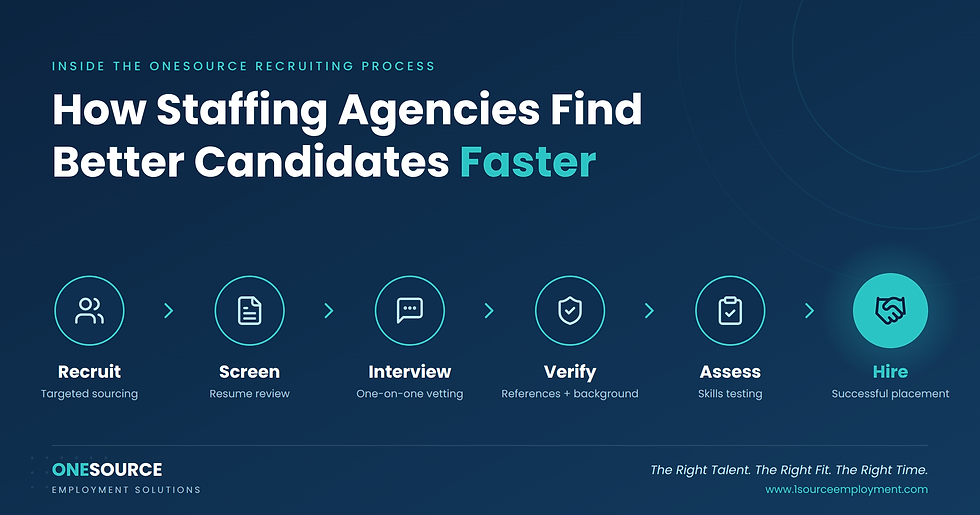
That's why our process includes:
Candidate sourcing
Pre-screening
Structured interviews
Reference verification
Skills matching
Culture fit assessments
Ongoing communication
We work with employers across:
Hospitality
Manufacturing
Property Management
Administrative
Professional Services
Skilled Trades
Because finding employees is one thing.
Finding the right employees is something else entirely.
Final Thoughts
Hiring will never be perfect.
But it can be better.
If there's one thing I'd encourage every HR manager and hiring manager to remember, it's this:
Slow down enough to hire correctly the first time.
The pressure to fill positions quickly will always exist.
The cost of a bad hire will always be higher.
Ready to Improve Your Hiring Process?
If you're tired of replacing employees every few months or spending valuable time interviewing candidates who aren't the right fit, we'd love to help.
At OneSource Employment Solutions, we help businesses throughout California build stronger teams through staffing, recruiting, and workforce solutions.
Whether you're hiring for a hotel, manufacturing facility, or property management company, our team is here to help.
Let's build your next great hire together.
Contact OneSource Employment Solutions today for a free workforce consultation.


Comments